The control centre of a living cell is the ...
Which of the following is not found in DNA?
Which one of the following carbohydrates is found in DNA?
In analysing the number of different bases in a DNA sample, the following result would be consistent with the base-pairing rules:
Which one of the components below is not directly involved in translation?
The statement that best describes a nucleic acid and a nucleotide is ...
nucleotides are monomers of nucleic acids.
nucleic acids are monomers of nucleotides.
nucleic acids are acids and nucleotides are bases.
nucleotides are large molecules and nucleic acids small molecules.
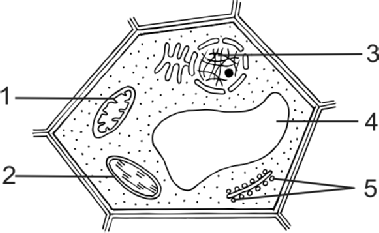
The carriers of the hereditary information are found in the part numbered ...
Question 7 (Questions 7 and 8 refer to the diagram alongside)
Proteins are synthesised on the part numbered ...
Question 8 (Refer to the diagram above)
Where are the molecules of DNA most likely to separate during DNA replication?
Phosphate ion and deoxyribose
Which one of the following statements is true of RNA?
It is always a double chain of nucleotides.
It is wound up as a helix.
During the replication of DNA, thymine always joins up with ...
Which compounds listed below together form a nucleotide?
The purine bases of the DNA molecule are ...
What is the complementary DNA sequence for the sequence A G T C?
Which DNA strand acts as a template during DNA replication?
The one with all four nitrogenous bases.
The first one to receive a nucleotide.
The transcription of T G A C produces ...
Transfer RNA transfers ...
All types of RNA are made of …
The exact copying of the information from DNA onto a messenger RNA takes place ...
The anticodon on t-RNA for A A A in a DNA molecule is ...
1. Phosphate ion; 2. 6C sugar; 3. Nitrogenous base; 4. Lipid; 5. 5C sugar
This is a learning exercise.
You must scroll to the top and examine your incorrect choices, with the view to improving your understanding of this topic. Refer to the Study Guide if necessary.
Questions source: DBE (Authorisation 11798)
Copyright Exam Fever. All rights reserved.
- Greg Gopaul -