Nucleus
Controls the activities of the cell and carries the genetic information.
Nucleolus
Synthesis of RNA and ribosomes.
Ribosome
Plays a role in protein synthesis.
Centromere
Joins chromatids together.
Centriole
Forms the spindle during cell division in animal cells.
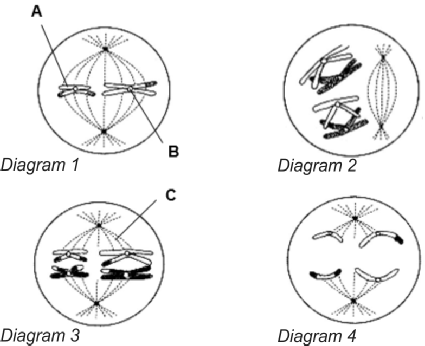
Name structures A, B and C. (3)
A: Chromatid/chromosome
B: Centromere
C: Spindle fibre/thread
Which phase is represented by: a) Diagram 1 and b) Diagram 2 (1)
Diagram 2: Metaphase 2
Diagram 2: Prophase I
Write down the numbers of the diagrams to show the correct sequence in which the phases occur. (2)
Diagram 2; Diagram 3; Diagram 1; Diagram 4.
Tabulate THREE differences between the first and second stages of meiosis. (7)

Name and explain TWO processes/mechanisms that ensure that the gametes produced at the end of meiosis are genetically different from each other. (4)
Crossing over. Pieces of chromatids/groups of genes are exchanged between homologous chromosomes.
Random/independent assortment of chromosomes. Maternal and paternal chromosomes assort themselves randomly/independently on either side of the equator during metaphase.

State the term that best describes the paired chromosomes labelled A. (1)
bivalent/homologous
Identify structure B. (2)
spindle fibre/spindle thread
What phase of meiosis is represented in the diagram above? (2)
metaphase I
How many chromosomes are shown in the diagram above? (1)
4
How many chromosomes would there be in each cell at the end of meiosis? (1)
2