Identify a plant hormone that:
promotes the development of buds, flowers and fruit. (1)
inhibits growth of seeds. (1)
brings about tropic responses in plants. (1)
promotes ripening of fruit. (1)
Starch stored in seeds is converted to glucose by enzymes at the beginning of germination. Gibberellins, which is synthesised by the seed embryo, triggers the production of these enzymes. Abscisic acid in the seed inhibits the production of gibberellins.
The graph below shows the relationship between gibberellins and abscisic acid over 50 days.
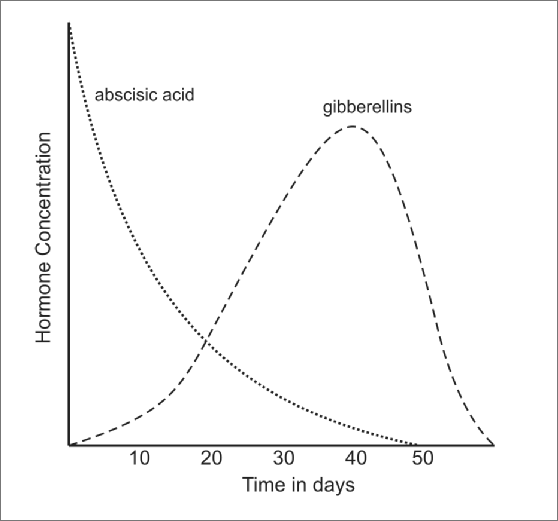
Name one hormone from the graph that promotes growth in plants. (1)
What effect does high abscisic acid levels have on the level of gibberellins? (1)
High abscisic acid levels inhibits gibberellins.
During the germination process, why must starch be broken down to glucose? (1)
Glucose is broken down during cellular respiration to provide energy.
Explain why there is a drop in gibberellins after 40 days have elapsed. (3)
Germination has taken place - seed's function ends.
A Grade 12 learner performed an investigation to determine the effect of light on the growth of plant shoots. The learner divided the plants that were used into three groups as follows:
Group A: The tip of the shoot was intact.
Group B: The tip of the shoot was removed.
Group C: The tip of the shoot was covered by a cap that does not allow light to pass through it.
The diagram below shows each shoot at the start of the investigation and at the end of the investigation.
The arrows indicate the direction of light for each group in the investigation.

Name the dependant variable in this investigation. (1)
Direction of growth of plant shoots.
State TWO factors that must be kept constant in this investigation. (2)
Same species of plant used.
Same period of time for seedlings to respond.
Same direction of light/temp/soil type/amount of water.
The influence of which plant hormone is being investigated? (1)
Explain the results observed in group A and C, as illustrated in the diagram above. (6)
INVESTIGATION A: (any 4)
Light from the right.
Caused auxins to move to shaded side of the shoot.
Leading to increased cell elongation and division.
There was therefore greater growth on the shaded side.
Thus bending the shoot in the direction of the source of light.
and
INVESTIGATION C:
Light has no influence on the distribution of auxins.
Therefore the shoot will grow upright.
This shows positive phototropism
State TWO ways in which the learner could improve the reliability of this investigation, making the results more acceptable. (2)
Repeat the investigation.
Use more than one plant for each treatment.
Thobeka investigated the effect of auxins on the growth of three plant shoots (A, B, and C). The plant shoots were treated as follows:
Shoot A: Not treated in any way.
Shoot B: Tip removed and agar plate with auxins placed on top.
Shoot C: Tip removed and agar plate without auxins placed on top.
NOTE: Agar is a jelly-like substance that allows auxins to diffuse through it.
The diagram below illustrates the set-up at the beginning of the investigation.
Identify the independent variable in the above investigation. (1)
Treatment of plant shoot, i.e. whether auxins are present or not.
State TWO factors that must be kept constant in this investigation. (2)
Same type of plant.
Placed in same environment.
Same amount of time.
Tip removed at same length.
Same concentration of auxin.
Same type of agar
(Any 2)
Explain the results observed in shoot B after a few days. (3))
Shoot B would show upward growth.
Auxin in agar gel diffused downwards into shoot.
Leading to cell elongation.
Explain the results observed in shoot C after a few days. (2)
No Growth in Shoot C.
Shoot tip contains no auxin.
Suggest TWO ways in which Thobeka could have improved the reliability of her investigation. (2)
Repeat the investigation.
Use more than 1 plant per investigation / increase the sample size.


Questions source: DBE (Authorisation 11798)
Copyright Exam Fever. All rights reserved.
- Greg Gopaul -