The diagrams below represent the skull, the upper jaw and lower jaw of three organisms, the Taung child (Australopithecus africanus), a modern human (Homo sapiens) and a gorilla (Gorilla gorilla). The arrow indicates the position of the forearm magnum (the opening that allows the spinal cord to connect with the brain). Study the diagrams and answer the questions that follow.

Identify the organisms that are represented by each of A, B, and C. (3)
A: Modern human (Homo sapiens)
B: Gorilla (Gorilla gorilla)
C: Taung child (Australopithecus africanus)
Assuming that the diagrams were drawn to scale, name TWO observable differences between the skulls of organisms A and B. (4))
Which organism (A, B or C) represents a carnivore? Explain your answer using features visible in the diagram. (2)
B. It has most developed canines.
Name TWO organisms that are best adapted for walking on two legs rather than four legs, by looking at the position of the foramen magnum (indicated by the arrows). (2)
Study the diagrams below of the upper jaw, skull and foot of two organisms A and B. The diagrams are NOT drawn to scale.
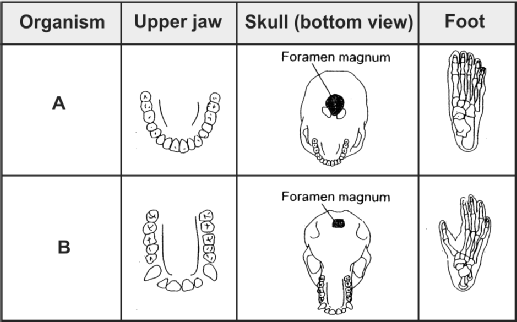
Tabulate TWO visible differences between the upper jaws of organisms A and B. (5)
Any 2 below.

Name ONE visible difference between the feet of organisms A and B. (2)
In A the big toe is close to the other 4 smaller toes/faces forward. In B the big toe is apart/opposable from the other 4 smaller toes/points outwards.
In A the heel bone is relatively larger and in B it is relatively smaller.
In A the bones in the feet are straight and in B they are curved.
In A phalanges are relatively shorter and in B they are relatively longer.
(Any 1)
Which organism (A or B) is more likely to be bipedal? Give a suitable reason for your answer (3)
Foramen magnum more towards the centre of the skull in A i.e. more forward. OR In B foramen magnum more towards the back of the skull.
Study the basic plans of the forelimbs of two different vertebrates shown below.

Are the above forelimbs homologous or analogous structures? Give an explanation your answer. (3)
Homologous. Are similar in structure (slightly different in function) suggesting a similar/common origin/ancestor.
Using the labels on the forelimb of a human as a guide, give the names of the letters A and B. (2)
A: humerus
B: matacarpals/phalanges/carpals
State TWO ways in which the forearm of the bat is adapted for flying. (2)
There is a wing/web of skin between the metacarpals/skin.
Forelimb and metacarpals are thin/light.
Forelimb and metacarpals are long.
Has a large surface area.
The peppered-moth, Biston betularia, has two phenotypes for body colour, dark (blackish) and pale (whitish). The trunks of the trees on which the moths rest are black in polluted environments compared to the white trunks of trees in unpolluted environments. In both unpolluted and polluted environments, birds are the predators of the moths.
An investigation was carried out to determine the number of dark and pale peppered-moths present in polluted and unpolluted environments using a sampling technique.
The results of the investigation are shown in the table below.
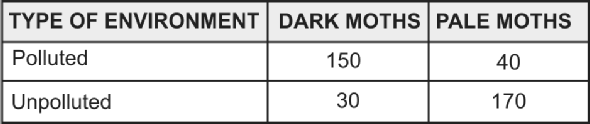
Formulate a hypothesis for the above investigation. (3)
More/fewer dark peppered moths/pale peppered moths survive in the polluted/unpolluted environment than in the unpolluted/polluted environment.
OR
No difference in the number of dark/pale peppered moths that survive in both environments.
Suggest THREE factors that might have decreased the validity of this investigation. (3)
Was not a closed system so moths could fly in and out of the environment.
The number of predators might have been different in both polluted and unpolluted environment.
Both environments could have been different with regard to vegetation found in them.
Both environments could have been different with regard to climatic conditions.
Using the table and your understanding of natural selection, explain the results for the polluted environment. (4)
Variation in the moth population produces dark and pale forms.
The dark moths were camouflaged by black tree trunks/not easily detected by birds/predators.
More dark moths survived/fewer eaten by birds.
Pale moths were NOT camouflaged by the black tree trunks/easily detected by birds.
Fewer pale moths survived/more eaten by birds.

Questions source: DBE (Authorisation 11798)
Copyright Exam Fever. All rights reserved.
- Greg Gopaul -