Exam Fever

Study the diagrams below showing a process of evolution. Diagrams 1, 2 and 3 show the sequence of events that occurred in rabbit populations over many thousands of years.

Question 1

Choose

Set 1

Set 2

Set 3

Set 4

Set 1

Set 2

Set 3

Set 4

Name the evolutionary process represented by the sequence of events shown in Diagrams 1, 2 and 3 above. (1)

Speciation

Describe the process you just mentioned using the diagrams above. (5)

In diagram 1 the rabbits were able to interbreed/ genes can flow freely in the population.

In diagram 2 the two populations were separated by the river/geographic barrier.

The two populations cannot interbreed/no gene flow.

Within each of the two separated populations there was variation.

Each group underwent natural selection independently as a result of varying environmental conditions.

Each group becomes genotypically and phenotypically different.

In diagram 3 the geographic separation no longer exist, but the two populations do not interbreed/no gene flow even though they can mix, because of the presence of reproductive isolating mechanism.

They are now 2 different species.

During the study of the fossil records the following timeline of homonids was constructed. Study the timeline and answer the questions that follow.

Question 2

How many million years ago did the hominid group split (at A) into two groups? (1)

5 mya

What is the main characteristic that caused the hominids to split into two separate groups at A? (1)

Larger brain

Which organism is thought to be the immediate ancestor of A. robustus? (1)

Australopithecus afarensis

List FOUR characteristics that primates and humans have in common. (4)

opposable thumb; bare finger tips; long arms; freely rotating arms; stereoscopic vision; eyes with cones and rods; few offspring; upright posture; bipedalism. (Any 4)

Study the cladogram below and answer the questions that follow.

Question 3

Name the two groups of hominids represented by the cladogram. (2)

Australopithecus and Homo

Name the common ancestor for the two groups named above. (1)

A. ramidus

Explain the term ‘common ancestor’. (2)

The organism from which all the subsequent animals evolved.

How long ago did this common ancestor exist? (1)

Accept 4,2 mya to 4,5 mya

Give the number of years ago when each of the following first came into existence: a) A. robustus; b) A. boisei; c) A. africanus; d) H. habilus (4)

a) 2.5 mya; b) 1.9 mya; c) 3.5 mya; d) 3.0 mya

With which hominid do Homo sapiens share a common ancestor? (1)

H. erectus

How many years ago did the species Homo sapiens appear? (2)

Accept 0,6 to 0,75 mya OR 600 000 to 750 000 years ago.
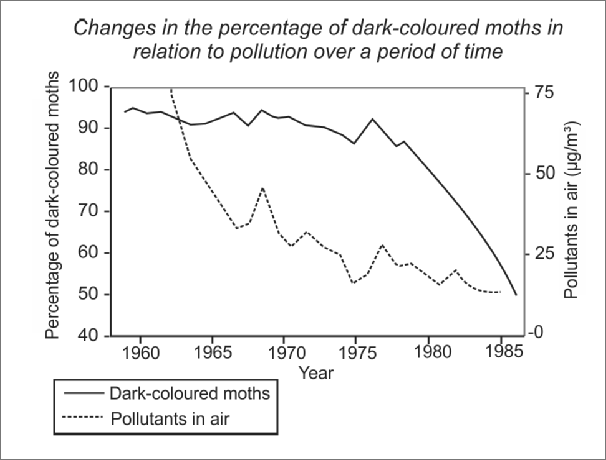
Before the Industrial Revolution took place in Britain in the 19th century, light-coloured moths that blended with the lichen-covered bark of trees were far more common than dark-coloured moths.

However pollution from factories killed the lichens on the tress leaving their dark bark exposed. The light-coloured moths were easily identified against the dark tree bark. The dark-coloured moths were easily camouflaged on the dark bark and soon became more common than the lighter varieties.

Now that pollution is decreasing the light-coloured moths are increasing in numbers again.

Study the following graph that shows the changes in the percentage of dark-coloured moths.

Question 4

What was the percentage of the dark-coloured moths in 1970? (1)

93% (accept 92 - 95)

What is the general relationship between the dark-coloured moth population and pollution from 1965 to 1985? (2)

As the pollution decreased the percentage of the dark-coloured moths also decreased.

Explain the relationship mentioned above. (2)

The dark-coloured moths are not being camouflaged/can easily be seen against the light lichen-covered bark and have become easier targets/prey for birds.


Questions source: DBE  (Authorisation 11798)

Copyright Exam Fever. All rights reserved.

- Greg Gopaul -