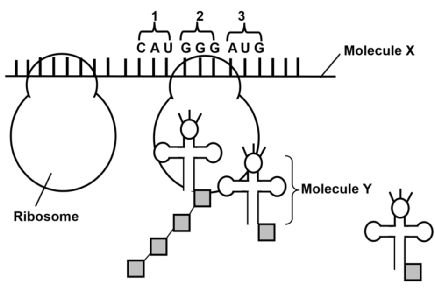
2.1   The diagram below shows a part of the process of protein synthesis.

Question 2

2.2  The table alongside shows the DNA base triplets that code for different amino acids found in human proteins.

Question 4

A double-strand section of DNA is composed of 30% adenine.  Complete the table below by clicking on the appropriate button, which indicates the name or percentage of each base present in the double-stranded section of DNA.   (4)

Say the answer aloud to yourself BEFORE clicking.

Question 4

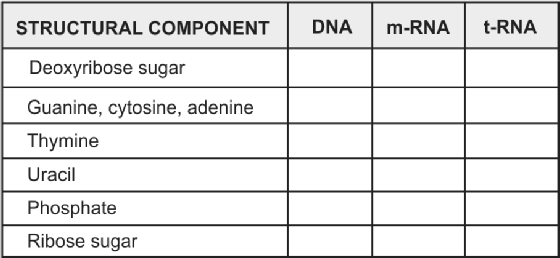
Determine whether the structural components listed in the first column is present in DNA and/or m-RNA and/or t-RNA.     (18)

Say the answer/s aloud to yourself BEFORE clicking.

Thymine

Guanine

20

20

Name the stage of protein synthesis represented in the diagram above. (1)

Translation

Identify: Molecule X: Molecule Y: Structure 1 (3)

Molexule X: mRNA

Molexule Y: tRNA

Structure 1: Codon

Using the information in the table and the diagram above, write down the sequence of the amino acids that correspond with structures 1, 2 and 3. (3)

Histidine, glycine, methionine (correct sequence) (3)

Question 3

List the steps involved in DNA replication. (10)

DNA unwinds and appears as a ladder.

The weak hydrogen bonds between nitrogen bases break and the two single strands move apart.

Each single strand picks up free nucleotides from the nucleoplasm and becomes double again.

The two new double strands are identical to each other and the original strand.

Each double strand now becomes twisted and a helical structure.

Set 1

Set 2

Set 3

Set 4

You are here

Set 1

Set 2

Set 3

Set 4

Choose

Exam Fever

Label the diagram below.

Question 1

Say the term/label aloud to yourself first before clicking on the?”.

hydrogen bonds

deoxyribose sugar

thymine

adenine

phosphate ion

sugar-phosphate bond

guanine

hydrogen bonds

deoxyribose sugar

thymine

adenine

phosphate ion

sugar-phosphate bond

guanine

Questions source: DBE  (Authorisation 11798)

Copyright Exam Fever. All rights reserved.

- Greg Gopaul -