Tabulate FIVE differences between DNA and RNA. (10)
image
The squence of nitrogenous bases of a small part of a strand of DNA which codes for part of a protein molecule is CGG --- TAT --- CCT. State the mRNA codon sequence of the DNA sequence above. (3)

GCC --- AUA --- GGA (in sequence)

Question 1

Question 2

The table below shows the tRNA anticondons and the corresponding amino acids.

Select from the table above, the amino acids (in the correct sequence) that would be required for the base sequence of mRNA given by: GGG --- CCA ---AGU. (3)

Glycine --- Proline --- Serine (in sequence).

Question 4

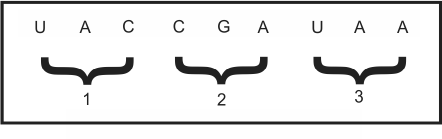
The following diagrams represent the process of protein synthesis.

3.1

How many codons are shown in the diagram above? (1)

3

Write down the complementary base sequence of the DNA strand that formed codon 1 of the mRNA strand in the above diagram. (1)

ATG.

Explain the purpose of a specific sequence of codons in a mRNA molecule. (2)

It determines the codes for the sequence of amino acids which determines the type of protein

3.2  A tRNA (transfer RNA) molecule carries complementary bases for a particular codon.

Write down the complementary base sequence of a tRNA for codon 1 in the mRNA sequence shown in the above diagram. (1)

AUG

Briefly describe the role of tRNA molecules during translation process of protein synthesis. (3)

tRNA picks up specific amino acids

its anticodon matches up with the codon of mRNA

therefore the amino acids are arranged in a particular sequence

to form particular polypeptides/proteins

Identify molecule M and organelle R. (2)

M - DNA

R - Ribosome

Write down the sequence of the first three nitrogenous bases on the DNA strand that led to the formation of Z. (2)

AGT

Name the part/stage of protein synthesis that is illustrated in O. (1)

Transcription

Question 3

The diagram below shows part of a mRNA  molecle.

4.2  The table below shows the base triplets of DNA and the corresponding amino acid.

With reference to the diagram and table above:

Name the amino acid labelled P. (2)

Threonine

State the base sequence of the molecule labelled Q. (2)

CCG

What name is given to the triplet of tRNA bases that code for each amino acid? (1)

Anticodon

Describe how the composition of the protein molecule changes if the base sequence at X was UGU instead of UCA. (2)

A different protein may form because it has cysteine instead of serine / have different amino acids.

Question 5

Provide labels for structures A, B and D respectively. (3)

A: Nuclear membrane

B: mRNA

D: DNA

State ONE function of molecule D. (1)

Carrying hereditary characteristics from parents to their offspring.

Controls the synthesis (manufacturing) of proteins/controls the structure and functioning of cells.

Which part of protein synthesis takes place at 1? (1)

Transcription

Name the type of proteins that control the process named in the question above. (1)

Enzymes

Identify organelle C. (1)

Ribosome

Name and describe the part of protein synthesis that takes place at organelle C. (6)

Translation

The mRNA strand from the nucleus becomes attached to a ribosome with its codons exposed

each tRNA molecule carrying a specific amino acid according to its anticodon

matches up with/complements the codon of the mRNA

so that the amino acids are placed in the correct sequence

adjacent amino acids are linked to form a protein

Set 1

Set 2

Set 3

Set 4

Set 1

Set 2

Set 3

Set 4

Choose

Image source (part): www.WPClipart.com

Study the diagram below which shows part of the process of protein synthesis.

Questions source: DBE  (Authorisation 11798)

Copyright Exam Fever. All rights reserved.

- Greg Gopaul -